
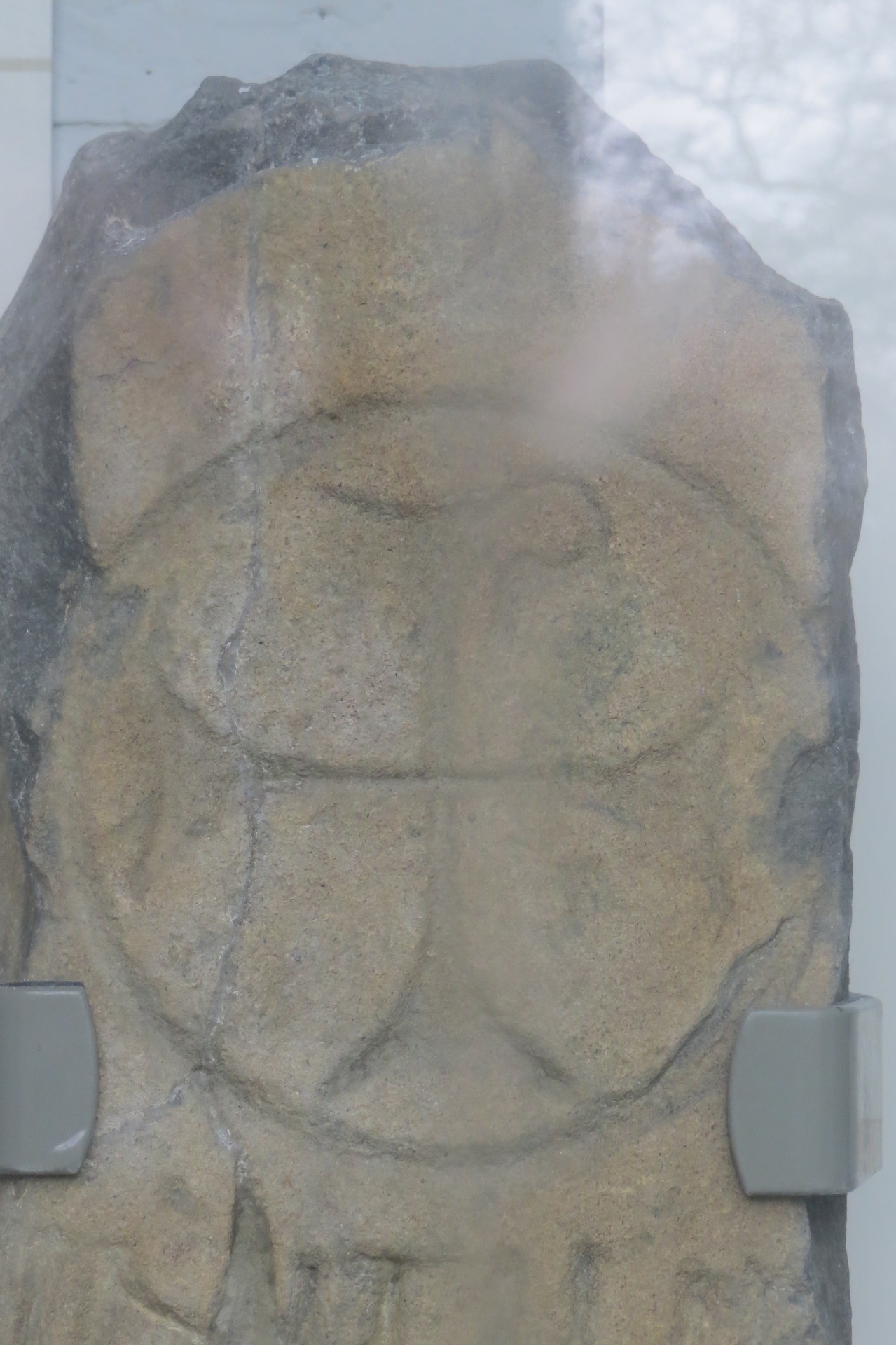
By CHE, licensed under CC BY 4.0
It is likely that our oldest Celtic crosses no longer exist because of the waves of pagan persecution in the early centuries of the church in Scotland in which Christian buildings, bibles and crosses were destroyed. A further wave of destruction took place in the 16th century Reformation, in which ancient crosses and pilgrimage shrines were also destroyed. In God’s providence we do still have some of the oldest Celtic crosses in the world, these being at Kirkmadrine, near Stranraer, in Galloway and Dumfries. The walk along a remote farm track near the village of Sandhead is rewarded by the sight of a mini museum in a small chapel displaying the Kirkmadrine Stones.
It is clear that this was once the site of a church led by Madrine in about AD 500. In the museum, which can only be seen through the window, there are Christian crosses from AD 500 to 1100, but it is the Kirkmadrine Stones 1-3 which are the earliest. Stone 1 has an inscription in Latin commemorating Viventius and Mavorius as ‘sancti et praecipi sacerdotes’ – ‘holy and chief priests’, which would mean bishops (episcopi). Stone 2 mentions two people, but the first name, with the exception of the ‘s’ has been lost, and the second name is Florentius. Stone 3 has the words inscribed, ‘initium et finis’ – ‘the beginning and the end’. In Revelation 1:8 and 22:13 Jesus says of himself: ‘I am the Alpha and the Omega, the Beginning and the End.’
On all three early stones there is a Coptic cross in a circle, forming a staurogram. A staurogram is an abbreviation of ‘the cross’ (with a ‘p’ on top of the vertical part of the cross) used by scribes on Christian gospels found in Egypt and dated at about AD 200. This shows us the Egyptian influence coming into the early church in Scotland from Martin of Tours in France, who mentored Ninian, the first known apostolic missionary to Scotland, and who was influenced by Anthony and the Desert Fathers of Egypt.