
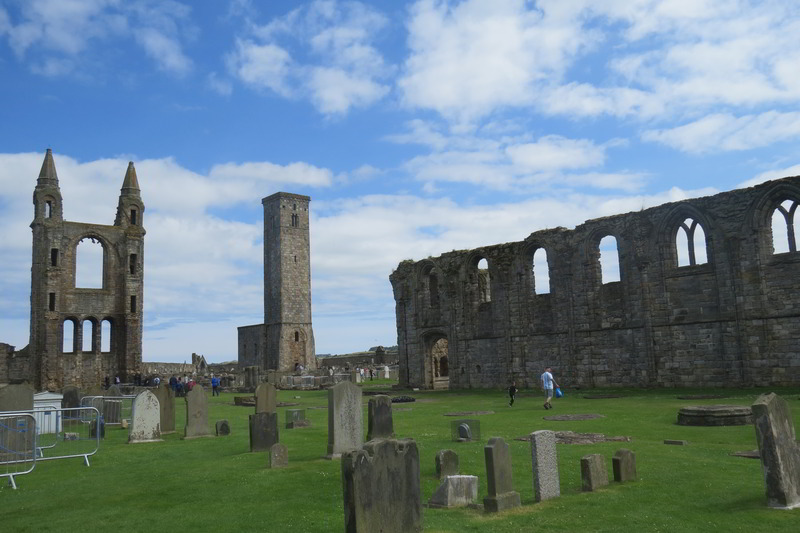
By CHE, licensed under CC BY 4.0.
Out of a storm-lashed sea a band of bedraggled Christians reached the Scottish shore from their ship. Regulus, an abbot and keeper of the relics clutched a box for all his worth, with twenty other refugees following him. While they rested on the sandy beach, Regulus recalled their adventure. On 6th May, AD 357 an angel had visited Regulus in Patras, Greece, instructing him to go to the sarcophagus which contained the bones of Andrew, the Apostle of Christ, and to take ‘three fingers of the right hand, the bone of the arm hanging down from the shoulder, one tooth, and the knee-cap…’ and with a group of trusted Christians, hide them. Just a few days later Constantius II came to Patras and plundered St Andrew’s sarcophagus, taking the relics to Constantinople. A few years later the angel returned and commanded Regulus to take the hidden relics ‘to the north-westerly ends of the earth…’ where he must establish a church to house them inside.
After his faithful band had recovered, they dedicated a church to St Andrew ‘in the Swine’s Wood, which is called, in the mother tongue, Mucrossis.’ According to later records miracles broke out: the blind, dumb, and crippled were healed through the relics, and crowds, hungering for supernatural healing, flocked there in droves. King Hurgust, son of Forgso, was so amazed by what he had seen that he built a palace near there and granted land to Regulus and his team. From this base they travelled far and wide preaching the message of Christ, with Regulus dying 32 years later after his arrival, being buried at Kilrymont, formerly called Mucrossis. Out of this would grow Scotland’s foremost medieval pilgrimage centre at today’s St Andrews.
The above record is taken from the Chronicle of the Scottish People, written by the Aberdeenshire monk John of Fordun in about 1360, although his history has been taken from earlier sources, which sadly do not exist today. As usual, modern academics pour scorn on such a history, labelling it as myth. Another tradition is that St Acca was exiled in AD 732 and, as a collector of relics, brought Andrew’s bones from Hexham Abbey in England, which was named after the same saint, to Kilrymont, which afterwards became known as St Andrews. In 1833 workmen were digging near the eleventh century church of St Regulus (St Rule) at St Andrew’s, when they came across an elaborate Christian sarcophagus, which has been dated at about AD 750. Scholars reckon it had been commissioned by the Pictish Christian King Óengus (Angus), or Onuist. This indicates that a church of importance had been there before that time.
Sadly the bones of St Andrew were destroyed during the Scottish Reformation, but the story has another twist: on the feast of St Andrew in 1879 a large portion of Andrew’s shoulder bone was placed in the Cathedral of St Mary’s in Edinburgh, which had been gifted by the Archbishop of Amalfi. A second bone was given to the Scottish Cardinal Gray by Pope Paul VI in Rome in 1969, with the words ‘Peter greets his brother Andrew.’ Since 1982 both relics have been placed in an altar of St Mary’s, making Edinburgh the custodian of the National Shrine of St Andrew today.