
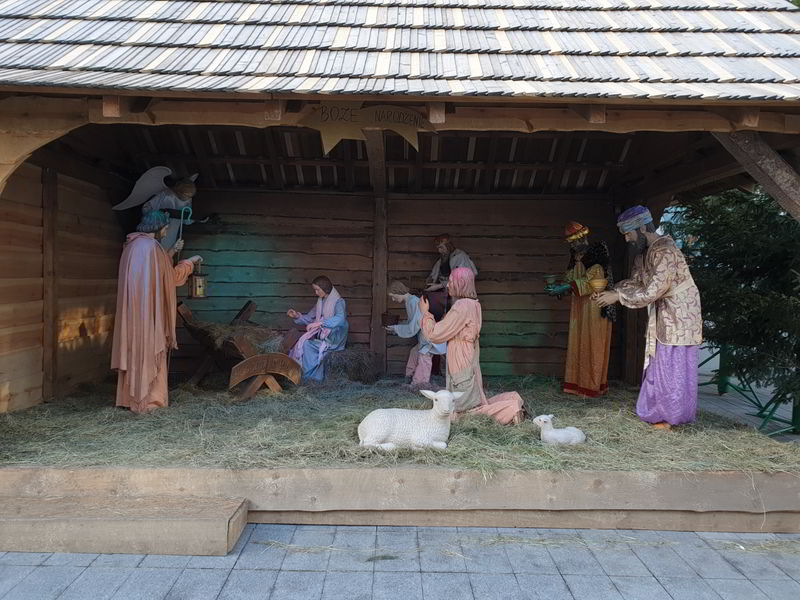
MichalPL, CC BY-SA 4.0, via Wikimedia Commons
.jpg)
As I look at the streets and homes where I live in Scotland, everywhere is filled with light. In almost every window there is a Christmas tree, and despite Covid-19 there is a great hustle and bustle going on as people make their last preparations to celebrate the season. It might come as a surprise to the reader to know that for almost four hundred years Christmas was banned from Scotland, but before I tackle that, let’s go to a scene on Lindisfarne.
This monastic community had been established there in the seventh century by the Scots from Iona. One day Cuthbert and two monks from Lindisfarne were cut off by foul weather on a Pictish island with no food. They had celebrated Christmas with their brethren on Lindisfarne, and they hoped to join them again for the Feast of Epiphany (6th January), but now in stormy and snowy conditions the situation looked bleak. After days of cold and hunger Cuthbert encouraged them, saying that God would provide a ‘banquet’ for them to enjoy his festival. He led them to the spot where he had spent the whole night praying and ‘there they found three cuts of dolphin meat, ready to cook, as though prepared by human hands’.
When Scotland broke free from Rome in 1560 a document of faith was drawn up called the First Book of Discipline. In this book the leaders believed that the various saints’ days and even festivals brought an infusion of pagan idolatry into the church and therefore must be banned. The ‘keeping of holy days’, they wrote ‘such as… Christmas [and] Epiphany’ should be ‘utterly… abolished from this Realm’ because ‘in God’s scriptures they neither have commandment nor assurance’. From 1560 until 1958 Christmas was banned from Scotland, except for a brief time during the control of the kings in the 17th century when they insisted on Christmas being celebrated. For religious Presbyterians the Christmas festival was a fusing together of Christ and paganism, or as Revd David Calderwood (1575-1651) expressed it: ‘December-Christmas is a just imitation of the December-Saturnal of the ethnic [pagan] Romans, and so used as if Bacchus [the god of revelry and drunkenness], and not Christ, were the God of Christians.’
This week Christians of almost all church denominations will be celebrating Christmas in Scotland, including most Presbyterians. Nobody can conclusively prove when Jesus was born as the early Jewish church did not celebrate Messiah’s birth. For many, 25th December is a celebration of his birthday, based on a tradition from the second century, which bloomed into the Christmas season as we know it by AD 336, and may have coincided with the Jewish celebration of Hanukkah at 25 Kislev when the lights are lit. For others every day is a celebration of Christ. But for all our readers who know and love Christ we wish you a Holy Spirit filled season and pray that you may know the Prince of Peace who troubles stormy seas in this difficult time. If you do not yet know Christ, we encourage you, like the Magi, to seek him, and when you find him, to rejoice with ‘exceedingly great joy’ (Matthew 2:10).