
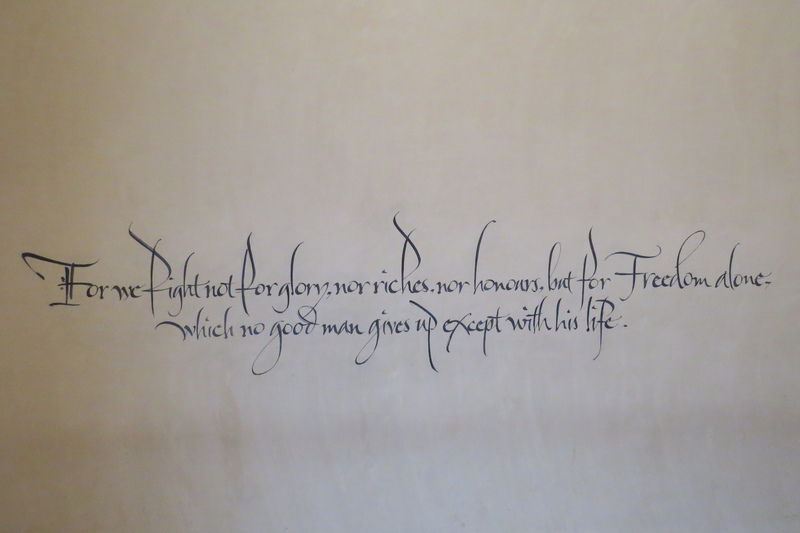
By CHE, licensed under CC BY 4.0. Text from the Declaration of Arbroath, National Museum
Scotland was facing a crisis. With no existing heir to the throne of King Alexander III a replacement had to be found. Of the potential contenders for the Scottish throne two stood out: John Balliol and Robert Bruce. But who should be the impartial arbiter in the discussions of the council? After much deliberation, they agreed upon someone: King Edward I of England, whose sister had been the first wife of King Alexander. Somehow it was hidden from the council that they would let a wolf in sheep’s clothing into the very heart of the nation.
It started to become more complicated when King Edward I later stated his condition: he would continue to act as mediator, as long as John Balliol would become King of Scotland under his rule – as a vassal king. The council was paralysed with the dilemma of refusing this request and facing the horrors of civil war in Scotland, or losing their independence under King Edward. In the silence, a lone voice spoke out: ‘The kingdom of Scotland is not held in tribute or homage to anyone save God alone.’ All looked up to see the resolute face of Robert Wishart, the bishop of Glasgow. Both Wishart, and his friend William Lamberton, the bishop of St Andrews, would become key players with Robert the Bruce and William Wallace in the struggle for Scottish independence in the long and brutal wars ahead.
The Council of Twelve, ignoring the bishop, agreed with King Edward’s request, and the Englishman returned home, delighted that Scotland was now firmly under wraps, to add to his conquest of Wales in 1283. Meanwhile, in 1292 John Balliol was dutifully inaugurated at Scone, as the King of Scotland and the vassal king of Edward. He would become known as Toom Tabard – ‘empty coat’, but after being deeply humiliated by Edward, John Balliol and his nobles revoked their allegiance to Edward. The English king, fuming with rage, invaded Scotland and burnt the town of Berwick, slaughtering 7,500 men and women there. It was this that led to the wars between 1296 and 1327.
The year 1320 has been enshrined as one of Scotland’s milestone years, for it was the signing of the Declaration of Arbroath by 51 Scottish leaders. In those days the church had such influence that the Scottish, by appealing to the Pope, could gain a vital ally in their struggle for independence from the English. The wording of the Declaration of Arbroath was well-crafted by the Abbot there to draw support from the Pope. They referred to their patron saint as ‘the most gentle Saint Andrew, the Blessed Peter’s brother’; then come the immortal lines: ‘as long as but a hundred of us remain alive, never will we on any conditions be brought under English rule. It is in truth not for glory, nor riches, nor honours that we are fighting, but for freedom – for that alone, which no honest man gives up but with life itself.’ An outline of English atrocities inflicted against them is followed in the Declaration by the desire of Scotland to help the Pope restore the Holy Land from Islam, if only he can intervene against the English. Abbot Barnard then plays his trump card: that if the Pope does not act on behalf of Scotland’s independence, the guilt would ‘be surely laid by the Most High to [his] charge.’
The message to the Pope worked. He began to exert his enormous influence on Scotland’s behalf, so that in 1328 Edward III announced ‘that the kingdom of Scotland shall remain forever separate in all respects from the kingdom of England, in its entirety, free and in peace, without any kind of subjection, servitude, claim or demand.’ To seal the agreement King Robert the Bruce’s son David was married to Joan, Edward III’s youngest sister.