
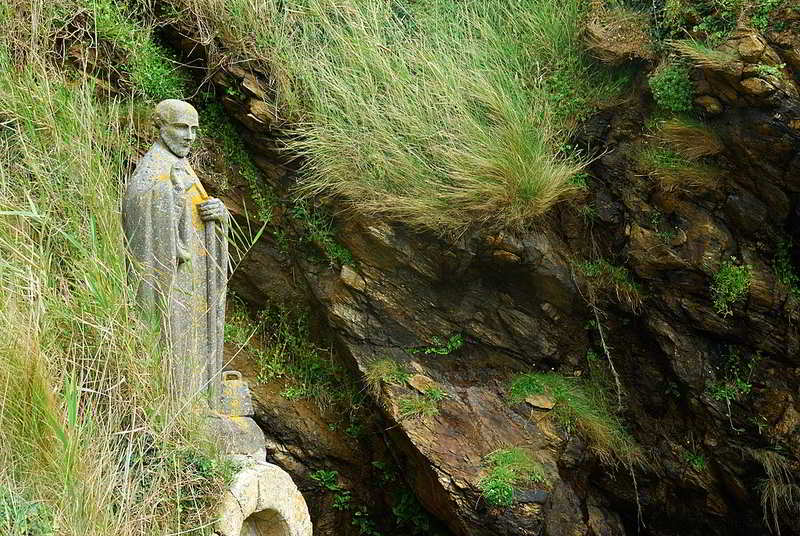
Romary, CC BY 2.5, via Wikimedia Commons

If Kentigern has been called the Apostle of Strathclyde in Scotland, Gildas, his contemporary, could be called its prophet. Both of the earliest medieval accounts of The Life of St Gildas place his birthplace near the River Clyde in what was once called the Kingdom of Alt Clut. He himself tells us in his polemic On the Ruin and Conquest of Britain (c.AD 546), that he was born in the same year as the Battle of Badon (c.AD 500), in which the hero, King Arthur, was supposed to have fought (according to later sources). Gildas was famed as a godly man of the Scriptures, and certainly his polemic is brimming full of quotations and allusions to both the Old and New Testaments.
Once he has given a brief history of Britain, Gildas launches into his diatribe against the wickedness of his fellow Britons. Nobody escapes his fiery preaching: kings, leaders, the common people, and the church – all are lambasted. ‘Britain hath priests, but they are unwise,’ he writes, ‘very many that minister, but many of them impudent… pastors (as they are called) but rather wolves prepared for the slaughter of souls… showing withal most depraved examples… despising the commandments of Christ.’ But this is not the work of a self-righteous and judgmental man; it’s a lament, like Jeremiah’s, and he is abased and broken as he writes. In his anguish he says ‘the subject of my complaint is the general destruction of everything that is good, and the general growth of evil throughout the land.’ His longing is for revival in the church, to see it restored to its first love of Christ and holy living, and to see his fellow Britons return to their faith.
Although Gildas’ character shines through his book, not much else is reliably known about him. Typically the medieval accounts are embellished with fanciful story-telling, but underneath this we can piece together the rudiments of his life. The earliest and most trustworthy of the accounts is by an 11th century monk of Rhuys in Brittany. According to him, Gildas studied at Illtud’s monastery in Wales, and also in Ireland. Hearing that his people in northern Britain had fallen away from the faith and were being confused with strange teachings, he went back and ‘all the nation of the northern region began to flock, from every quarter, to the doctrine which he preached’. His preaching, we are told, was accompanied by miracles and he established many churches there. King Ainmericus, hearing about the good work he was doing, asked him to come to Ireland, where he also saw a breakthrough. After many adventures in Rome, he settled in Brittany, where he built a monastery and an oratory, becoming a renowned and beloved Bible teacher. He died and was buried at Rhuys in France in AD 570.