
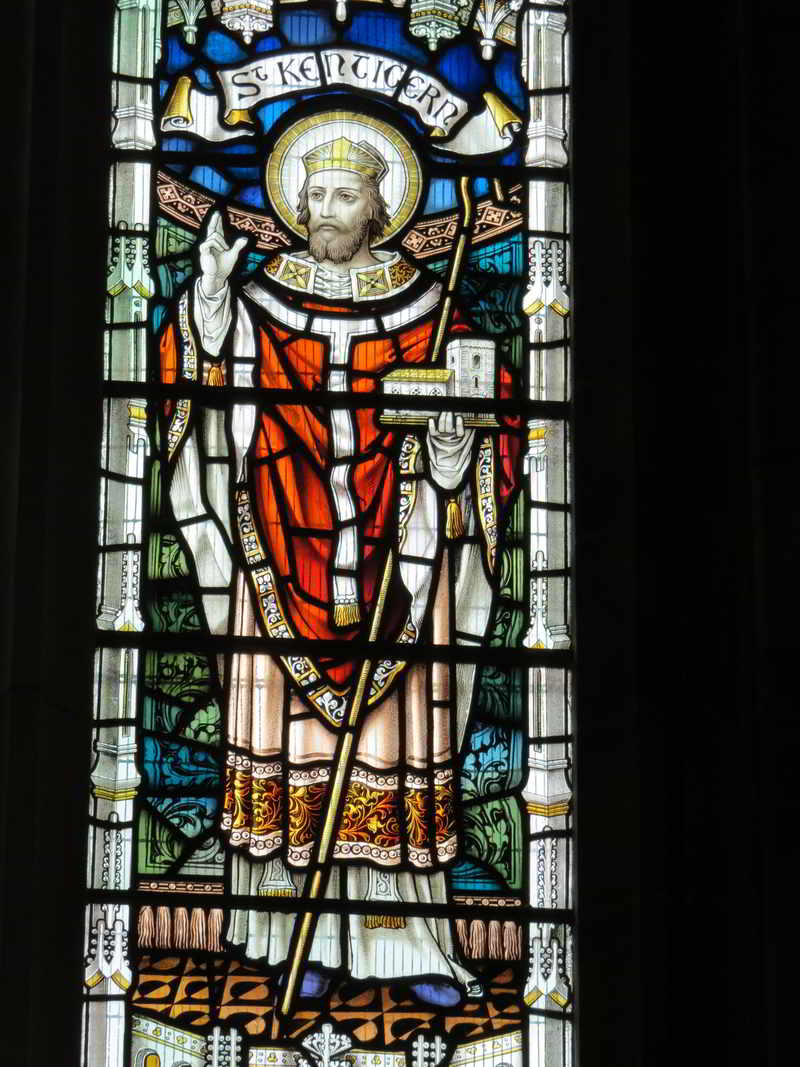
By CHE, licensed under CC BY 4.0.
Princess Thaneu wept as the coracle drifted with the currents in the Forth Estuary. Her father, King Leodonus (Loth) of the Gododdin tribe, had angrily insisted that she should be thrown off the steep edge of Traprain Law. Her crime was that she was pregnant outside marriage, but her plea of being an innocent victim of rape fell on deaf ears. Miraculously she and her baby survived the fall, so instead she was taken to the sea to be set adrift at the mercy of the gods. The coracle came to rest at Culross near the monastery of Serf (Servanus), where she gave birth to a son who would be called Kentigern, or Mungo.
The above story comes from the written record of an unknown monk, which is simply known as the Fragment of the Life of St Kentigern, dated from the twelfth century. The monk claims to be writing his account for Herbert, the bishop of Glasgow. ‘I have… composed a sort of work,’ he says, ‘from the material found in the little book of virtues, and from the oral communication of the faithful made to myself.’ We do not know which book he meant, so it must have been an early record of Kentigern’s life that has been lost. Certainly his ragged remains seem to have more of a historical feel than the later version by Jocelinus, the monk of Furness.
Thaneu and her baby were taken in by Serf and his community at Culross and cared for. Serf had developed a school there for training up young men in the Christian faith. Kentigern was taught there from childhood and from an early age showed signs of a passion for Christ, being consecrated as a bishop later in about AD 540 by a group of Britons from Cumbria and a bishop from Ireland. Jocelinus, whose basic facts can be trusted, tells us that ‘he established his cathedral seat in a town called Glesgu, which is interpreted as The Family, and is now called Glasgu [Glasgow].’
According to Bede the Britons had accepted the gospel in AD 156 at the time of King Lucius [actually AD 179], and the message of Christ spread north into southern Scotland about 50 years later. Waves of persecution, famine, disease, false teaching, and ignorance had broken out against the church, so that by the time Kentigern set up his base in Glasgow, there was a great need of solid Bible teaching and leadership. Gowned in a white robe and holding his wooden staff, he preached and taught the Britons in the Strathclyde area. Jocelinus tells us: ‘Wherefore that renowned warrior began to overthrow the shrines of demons, to cast down their images, to build churches… to ordain clergy’. His simple and obedient faith was accompanied by miraculous signs: ‘For he restored sight to the blind, hearing to the deaf, the power of walking to the lame, speech to the dumb, reason to the insane. He drove away fevers; he cast out devils…’
Despite persecution from the pagan King Morken, with temporary exile, he established his cathedral of praise in Glasgow with 965 monks, and trained up teams to preach and plant churches far and wide.