
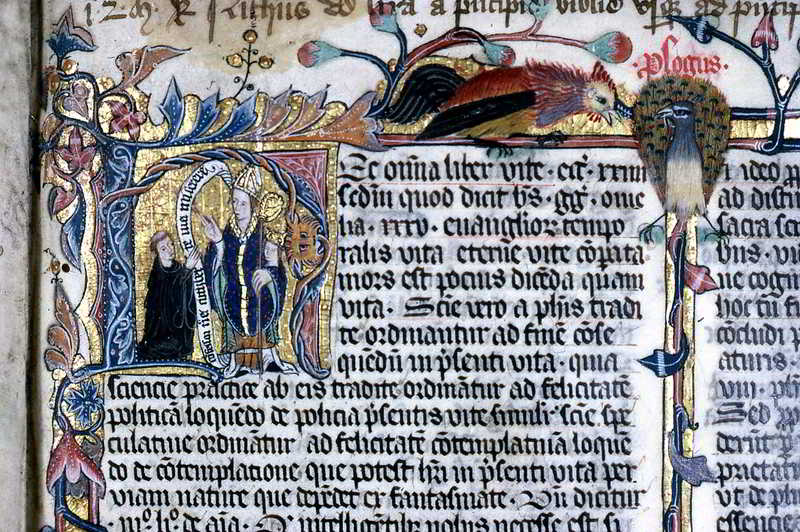
Image: St Cuthbert with King Oswald’s head, Durham Cathedral, A.1.3_trans352
The medieval period in Europe has derisively been called ‘the Dark Ages’, and yet scholars are beginning to realise that it was the church that mostly advanced our culture, founding universities and schools all across Europe, developing science, healthcare and medicine, for the betterment of mankind. In this great period Oxford and Cambridge Universities were founded by the monastic orders, and here in Scotland St Andrew’s University was pioneered in 1410 by the church, followed by Glasgow and Aberdeen Universities later that century. Bishop William Elphinstone, who founded Aberdeen University, was also one of the key movers of the first printing press in Scotland. Together, with Hector Boece, Elphinstone produced The Aberdeen Breviary, the first book printed in Scotland by Edinburgh’s Andrew Myllar and Walter Chepman in 1507. It was a book promoting the saints of Scotland, showing raw nationalism and spirituality. Without the church in Scotland we would have had no records of our history; almost all of the documentation that is invaluable for historians and archaeologists today comes from the Christian scribes and scholars. Some of their pieces of artwork have become national treasures.
It was through the monastic orders that our nation became more educated; it was the monks that paved the way for scholarship, lifting Scotland out of a backwater and thrusting it into recognition in Europe. They were part of a movement in philosophy and science that prepared the way for advances in the Reformation period through to our modern day. James Hannam, whose Ph.D. at the University of Cambridge in the history of science, wrote in his book, God’s Philosophers: How the Medieval World Laid the Foundations of Modern Science: ‘So prevalent did rational argument become among philosophers during the Middle Ages that the period deserves to be thought of as the beginning of the ‘Age of Reason’.
It was the monks who provided healthcare in Scotland, as in Europe. The biggest hospital in our nation in this period (1164-1460s) was the ‘House of the Holy Trinity’ at Soutra Aisle, a building measuring about 700 square metres. The monks however, were not just busy developing education, healthcare and science: they were also at the forefront of business, bringing wealth and work to many. Not far from where I live the monks at Newbattle Abbey pioneered the coal mining industry in Scotland, as well as playing a significant part in developing the production of salt, and other commodities. It was the monks too, who invented whisky in Ireland by 1405, and we find a Friar John Cor producing the first recorded rough Scotch whisky at Lindores Abbey in Fife in 1494/5, and having a request from King James IV for about 500 bottles of this aqua vitae.