
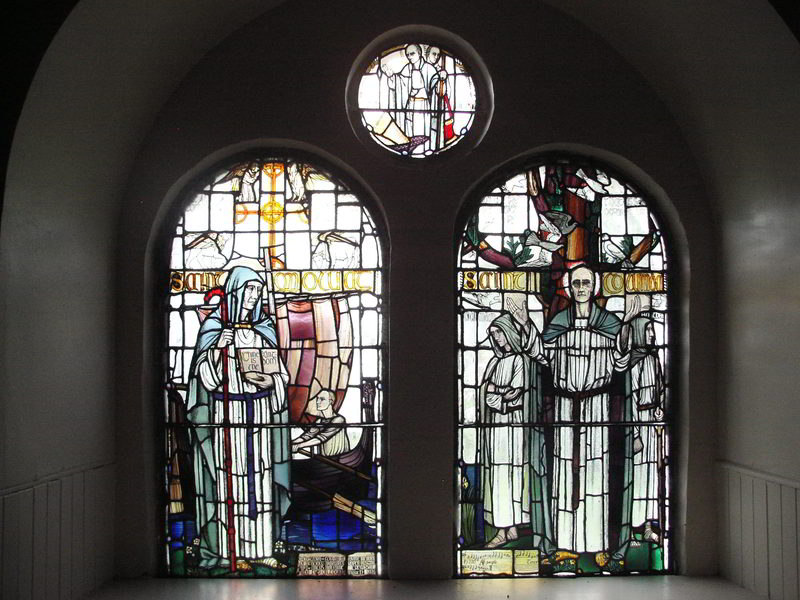
One of Columba’s rugged fellow apostles in the sixth century was Moluag of Lismore in Argyll. Unfortunately most of our information about him comes from later medieval works, and even this is scanty. He was ordained by Comgall who founded the famous Bangor Abbey in Ulster. Comgall himself had been taught by Finnian of Movilla Abbey, also in Ulster, who had been trained at Candida Casa at Whithorn in Scotland. Ninian, who founded this mission and teaching base at Whithorn, named the church after his mentor, Martin of Tours in France. Out of Martin of Tours’ dual model of monastic retreat for prayer, followed by energetic mission to establish the Christian faith in the strongholds of paganism, poured a stream of monastic missionaries in Scotland and Ireland, such as Columba and Moluag.
Just as Columba went straight to the pagan stronghold of King Bridei (or Brude) near Inverness to challenge the power of the druids, Moluag went to Lismore in about AD 562, which was known to be the stronghold of the pagan kings in Argyll. Indeed the island of Lismore was the most sacred place for the Western Picts, and their kings were cremated on Cnoc Aingeil, (‘Hill of Fire’), near Bachuil. It was near here that Moluag chose to establish his first monastic missionary base. According to tradition Moluag established over 100 monastic mission bases in Scotland amongst the Picts, right up to Rosemarkie, north of Inverness and Mortlach parish, in Moray, as well as on Lewis. His life must have been as eventful as his friend Columba, as recorded by Adomnan, but whatever early records there once were have been lost. In the Annals of Ulster dated at AD 592, we simply read: ‘Death of Lugaid of Les Mór’, or Moluag of Lismore.
There is a charter from 1544 in which the Earl of Argyll refers to ‘saint Moluc, our patron.’ It is very likely that at one time he was the patron saint, not just of Argyll, but perhaps of Scotland. Today the McLea clan, or Livingstone of the Highlands, are believed to be the custodians of Moluag’s crozier, and the direct descendant of this ancient family is the Coarb, or successor, who is the hereditary keeper of this staff, known as Bachuil Mor. Moluag’s bell, with which he called people to worship, once existed too, but disappeared during the Reformation. An ancient Pictish cross with elaborate markings and dated at about AD 780 can be found near to where Moluag was buried at Rosemarkie.