
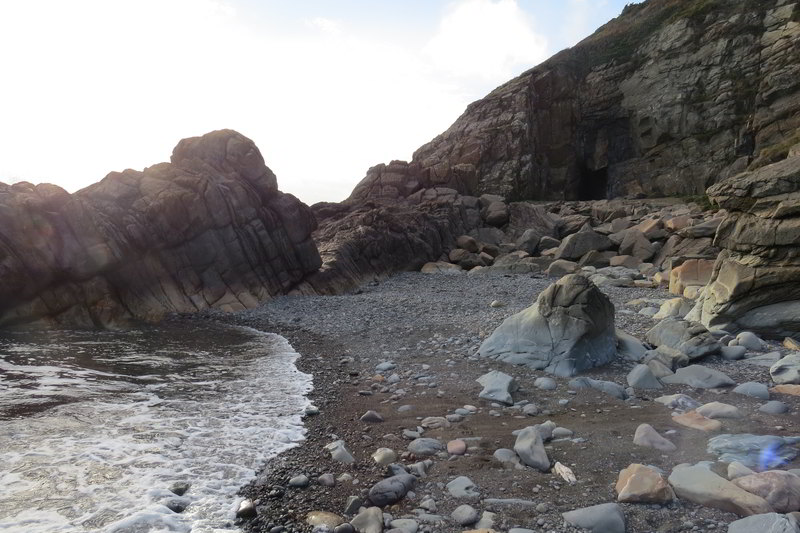
By CHE, licensed under CC BY 4.0.
With growing anticipation we approached Ninian’s Cave¹ near Whithorn. At first we could not see any cave, but then we made out the opening in the cliff rock. As with so many of the early missionaries in Scotland, he had chosen a beautiful spot overlooking the sea. Inside the cave there were numerous crosses etched into the rock by pilgrims, some going back centuries, and a plaque giving a brief history. Although there had been Christians in Scotland before his time, our mission history in this nation traditionally begins with him.
‘The southern Picts, who live on the other side of the mountains,’ wrote Bede the historian, in AD 731, ‘are said to have abandoned the errors of idolatry long before this date [AD 565] and accepted the true Faith through the preaching of Bishop Ninian, a most reverend and holy man of British race, who had been regularly instructed in the mysteries of the Christian faith at Rome.’ ²
Bede goes on to tell us that Ninian built the ‘Candida Casa, the White House’ of stone, rather than the usual wattle and daub church. The church was named St Martin, after Ninian’s mentor, Martin of Tours in France, who died in AD 397 – the same year this church was finished. It was from Martin that Ninian learnt the missionary monastic model of prayer retreats in the cave, followed by bold evangelism. It was this same model that the missionaries in Scotland and Ireland followed later.
An account of The Life of S. Ninian exists, which Ailred, the Abbot of Rievaux, translated from the ‘Anglic language into Latin’ in the 12th century. Ailred complains about the ‘barbarous language’ which he thought obscured the ‘most holy Ninian’, and then proceeds to translate in an embellished and polished way to suit his refined audience. We have to sift out the exaggeration, legend and fiction, but after we have done that, a hard core of fact remains: Ninian clearly had an important apostolic impact on southern Scotland, preaching the gospel, training up preachers, establishing churches, and seeing breakthroughs amongst the pagan Britons and Picts. Signs and miracles accompanied his preaching, as with the other early missionaries to Scotland, and a life of prayer and holiness emanated from him. Thus Ninian established a Christian movement, which would take root and bear good fruit.
¹ Can you find Ninian’s Cave in the photo with this post?
² Bede, A History of the English Church and People, p.146, Penguin Classics, 1983.