
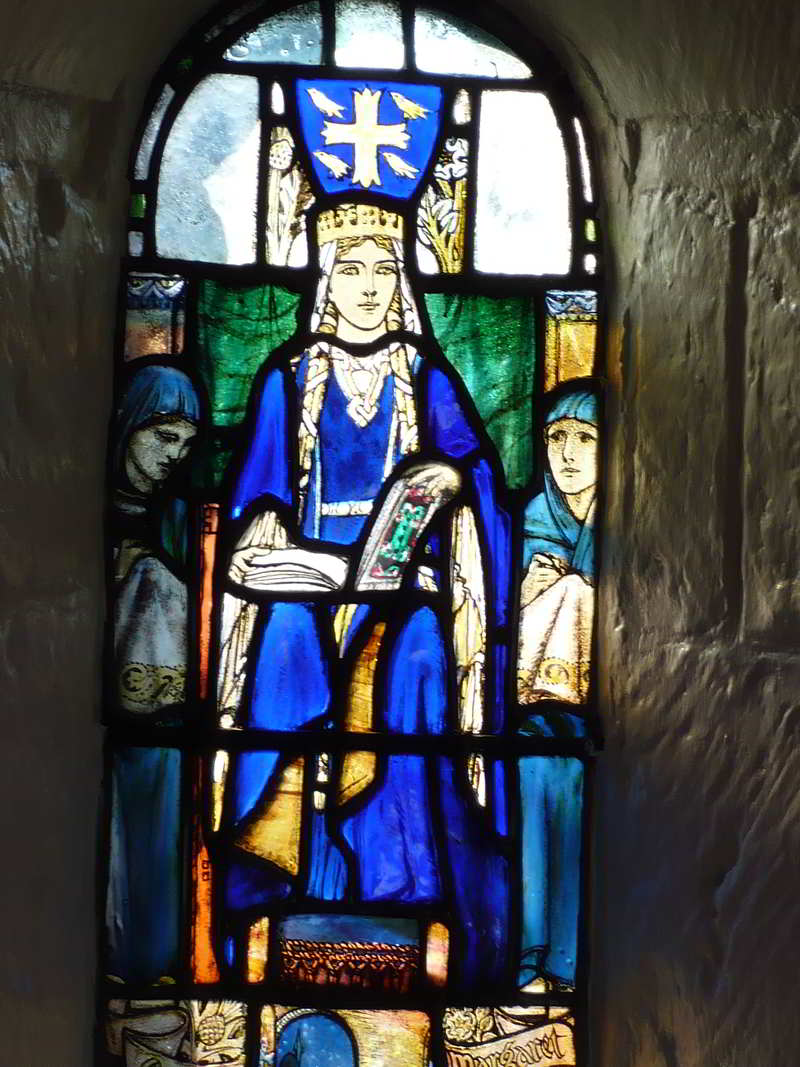
By CHE, licensed under CC BY 4.0.
It is not often that a queen washes the feet of the poor in her castle. Nor is it usual for such a person to impact a nation through her godliness, practical kindness and love, so that Scotland produced its golden age of kings, because of her example.
When Turgot, bishop of St Andrews, was requested by Matilda, the wife of King Henry I, to write a biography of her saintly mother, Queen Margaret, he compiled Life of St Margaret, Queen of Scotland, between seven and fourteen years after she had died in 1093. As Queen Margaret’s private confessor he knew her better than anyone. He tells us ‘God is my Witness and my Judge – that I add nothing to the truth.’ Having a deep dislike of embellishing a biography for sensational purposes, his account is deliberately downplayed for fear that he might be charged with ‘decking out the crow in the plumage of a swan’.
Margaret, whose grandfather was Edmund Ironside, the King of England, would have preferred to have lived the life of a nun, but she was destined, however, to affect the course of Scotland. Fleeing danger from the hands of William the Conqueror she arrived in Scotland with her mother, brother, and sisters, and was taken to King Malcolm III. Malcolm fell in love with Margaret at first sight, but she deterred him, preferring the life of a celibate Christian. With much persuasion from her family, she finally married Malcolm. Thus begins an extraordinary account.
Turgot writes, ‘When she went out of doors… crowds of poor people, orphans and widows, flocked to her, as they would have done to a most loving mother.’ Often she would greet them at a rock near Dunfermline where she would be available for counsel, prayer and practical help. Every morning she fed nine orphans with her own silver spoon. Regularly 300 of the poor would dine with her and King Malcolm, and she would wait on 24 poor people every day, serving them food and drink. Besides this she sent spies throughout Scotland to report where the English were enslaved by cruel owners, so that they could be ransomed and set free. Often she would visit hermits and monks to find out where the poorest people were, so that they could be helped. She took her New Testament everywhere with her and would sometimes even correct the bishops about biblical matters.
Margaret’s motivation was a deep love for Christ. She repeatedly asked Turgot to rebuke her if he found any sin or worldliness in her; her desire was to be humble and virtuous, hating flattery and greed. ‘In church… she was there simply to pray, and in praying to pour forth her tears’, said Turgot. Her passion for God was demonstrated too, in the building of Dunfermline Abbey, the rebuilding of the abbey at Iona, which had been destroyed by the Vikings, and other churches, and her pioneering work of establishing a free ferry to enable the pilgrims to cross the Forth estuary on their way to St Andrews. Today both South Queensferry and North Queensferry are named after her, as is Queen Margaret’s University. Beyond this she worked with her husband, introducing good laws in the land, increasing foreign trade, and making Edinburgh a centre for the arts. No wonder she was called ‘the Pearl of Scotland’.