
By CHE, licensed under CC BY 4.0.
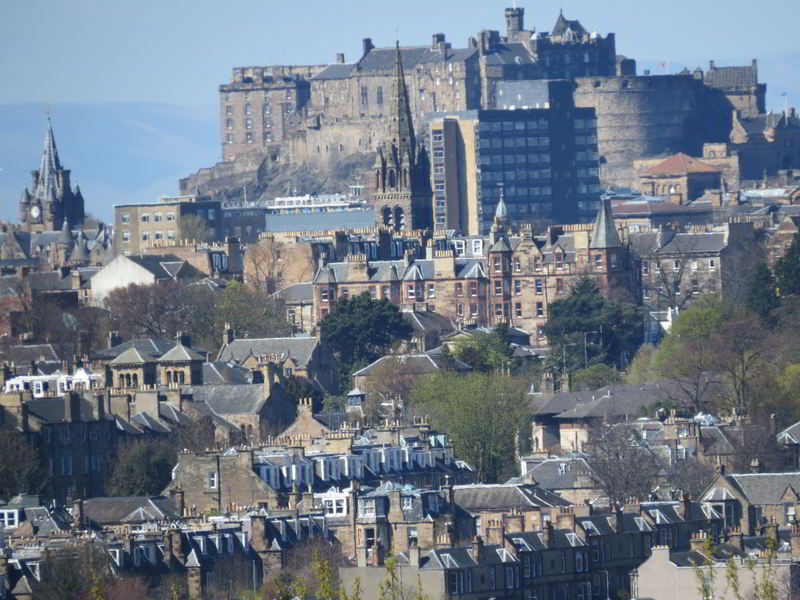
Edinburgh Castle: taken from Craigmillar Castle by Paul James-Griffiths. Adam Wallace was burnt for his faith in Christ in 1547 on Castle Hill, just below Edinburgh Castle.
Following the death of George Wishart, the next recorded martyrdom in the Scottish Reformation was that of Adam Wallace of Kyle, who in 1547 perished in the flames on Edinburgh’s Castle Hill. Wallace was captured and brought before the council gathered at the Black Friars’ Church in Edinburgh on a charge of heresy. The account comes from John Foxe’s Book of Martyrs.
Standing before earls, bishops, and abbots, he was cross-examined by John Lauder clothed in a surplice and red hood. ‘Adam Wallace, alias Fean,’ said his accuser, ‘you are openly accused for preaching and teaching of the blasphemies and abominable heresies under-written: In the first you have said and taught that the bread and wine on the altar, after the words of consecration, are not the body and blood of Christ.’ Wallace turned to the whole court, saying, ‘I never said, nor taught anything but what I found in this book (having a Bible at his belt in French, Dutch, and English), which is the word of God.’ Asking the court to judge him by God’s Bible meant that he was exposing the corrupt nature of the Romanist teaching, which taught that the communion literally became the blood and body of Christ at the Mass when the priest consecrated it, a belief known as transubstantiation.
‘You have said and openly taught,’ replied the Bishop of Orkney, ‘that the God which we worship is but bread sown of corn, growing out of the earth, baked of men’s hands, and nothing else.’ Wallace answered, ‘I worship the Father, the Son, and the Holy Spirit, three persons in one Godhead… But I know not which God you worship.’ Infuriated, the bishop explained the Romanist’s teaching that the priest consecrated the sacrament so that the Mass became ‘the very body and blood of the Son of God, and God Himself’. Standing his ground Wallace warned the court: ‘If you condemn me for holding by God’s word, my blood shall be required at your hands, when you shall be brought before the judgment seat of Christ, who is mighty to defend my innocent cause.’
With that the court sentenced him as guilty and delivered him to the provost of Edinburgh to be burnt on Castle Hill. Wallace was imprisoned in a tall building, shackled by chains on his legs and neck. Firstly two Franciscan friars were sent to instruct him, but he refused to communicate with them; then two Dominican friars, followed by an English friar, then a philosopher called Arbuthnot. His Bible was taken away from him ‘but he would consent to nothing that had not evidence in the holy scripture, and so passed that night in singing, and praising God.’
When he was taken to the execution spot he was fastened to his funeral pyre. Looking intently to heaven several times he called out to the assembled crowd: ‘Let it not offend you that I suffer death this day for the truth’s sake; for the disciple is not greater than his master.’ The provost, fuming with rage at Wallace’s audacity, inspired Wallace’s last words. ‘They will not let me speak’, he cried out. Then the fire was lit, ‘and so he departed to God constantly, and with good countenance.’
‘And they overcame him [Satan, the accuser] by the blood of the Lamb, and by the word of their testimony; and they loved not their lives unto death.’ (Revelation 12:11)