
By CHE, licensed under CC BY 4.0.
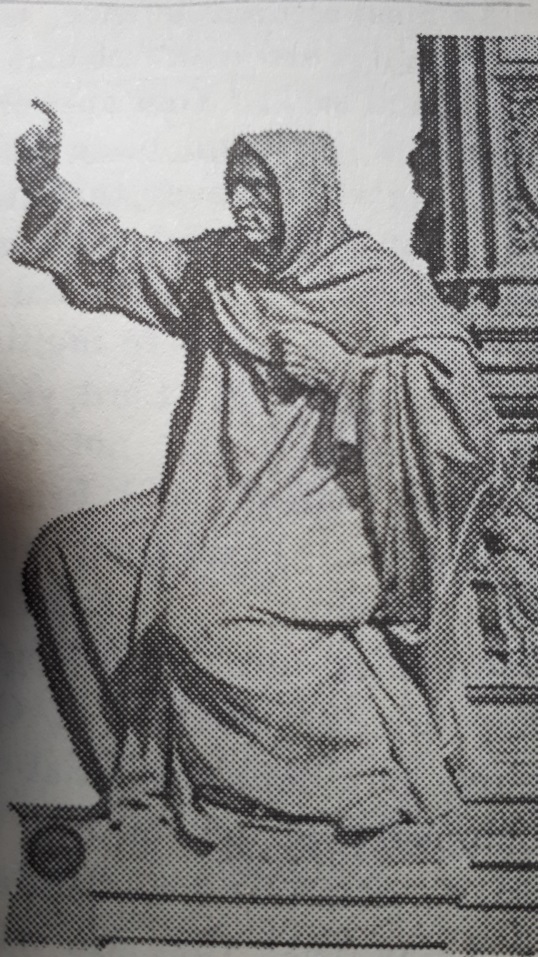
Image: A friar preaching during the Reformation
The horrific death of Patrick Hamilton in 1528 shook those at the University of St Andrews, particularly at the College of St Leonard’s. Both the Rector Gavin Logie, and the Vice-Abbot, John Winram, began a careful investigation of what Hamilton had preached. Both were converted to Christ and Logie especially sought to spread the gospel among the students, but he was exiled for his preaching in 1534. The message that had been sealed in Hamilton’s blood, however, would take deep root at this college, so that it was said of those who preached the gospel: ‘You drank at the wells of St Leonards.’
St Leonard’s was one of the leading monasteries in Scotland with strong connections to twenty other monasteries of the Augustine Order; the flame that had been lit at St Andrews spread throughout them all. From the Augustinian monks the fire spread to the other orders. John Knox wrote that ‘within a few years thereafter, began both Black Friars [Dominicans] and Greyfriars [Franciscans] publicly to preach against the pride and idle life of the Bishops, and against the abuses of the whole Ecclesiastical Estate.’
Alexander Seton, a Black Friar, preached for the whole period of Lent on the Ten Commandments, holding up God’s Law as a mirror so that the people could see their own sin. It was so bad in Scotland that the population did not even know God’s Law, because the bishops and priests had largely failed in their task. The ignorance was so acute, that some of the priests thought that Martin Luther had invented the English New Testament, and the Bishop of Dunkeld exclaimed, ‘I thank God that I never knew what the Old and the New Testament was [sic].’ Friar Seton then followed his teaching on God’s Law by telling the Scots that they should repent (turn from) their sins and trust in Christ alone as their Lord and Saviour for forgiveness of sin and eternal life.
As a learned man he had been placed in the position of Confessor to King James V, where he began to influence him in the way of God. Archbishop Beaton feared that their sovereign might be converted to Christ, and at the same time Seton was exposing the corrupt bishops as ‘belly gods’. Archbishop Beaton, fuming with rage and indignation, realised that Friar Seton was protected by the king, so he roped in some hypocritical Greyfriars to accuse him of heresy. Seton, hearing about this, fled to England where he ‘with great praise and comfort of many, taught the Evangel [gospel].’ The Apostle Paul wrote in Galatians 3:24: ‘Therefore the law was our tutor to bring us to Christ, that we might be justified by faith.’